
Summers are getting hotter. Swelter helps you answer one question: how risky is it to be active outdoors right now?
Swelter runs on wet-bulb globe temperature (WBGT), the standard heat stress index, used worldwide for decades to decide when to limit outdoor activity. Swelter is powered by Apple Weather data to give you hyper-local forecasts for your current location.
Swelter is built privacy-first, and we are supported entirely by Swelter Pro subscriptions. WBGT is calculated entirely on your device. The only thing your location data is used for is to retrieve data from Apple Weather, and it is never shared with us and never sold.
What Swelter Does for You
Swelter’s key feature, which is completely free, forever (other features may require a Pro subscription), shows you the current WBGT, the current heat-risk flag and guidance, and lets you view conditions for the entire day. This is the core utility of Swelter: how favorable is it right now for a run or any outdoor activity, or is it risky to be active outdoors right now?
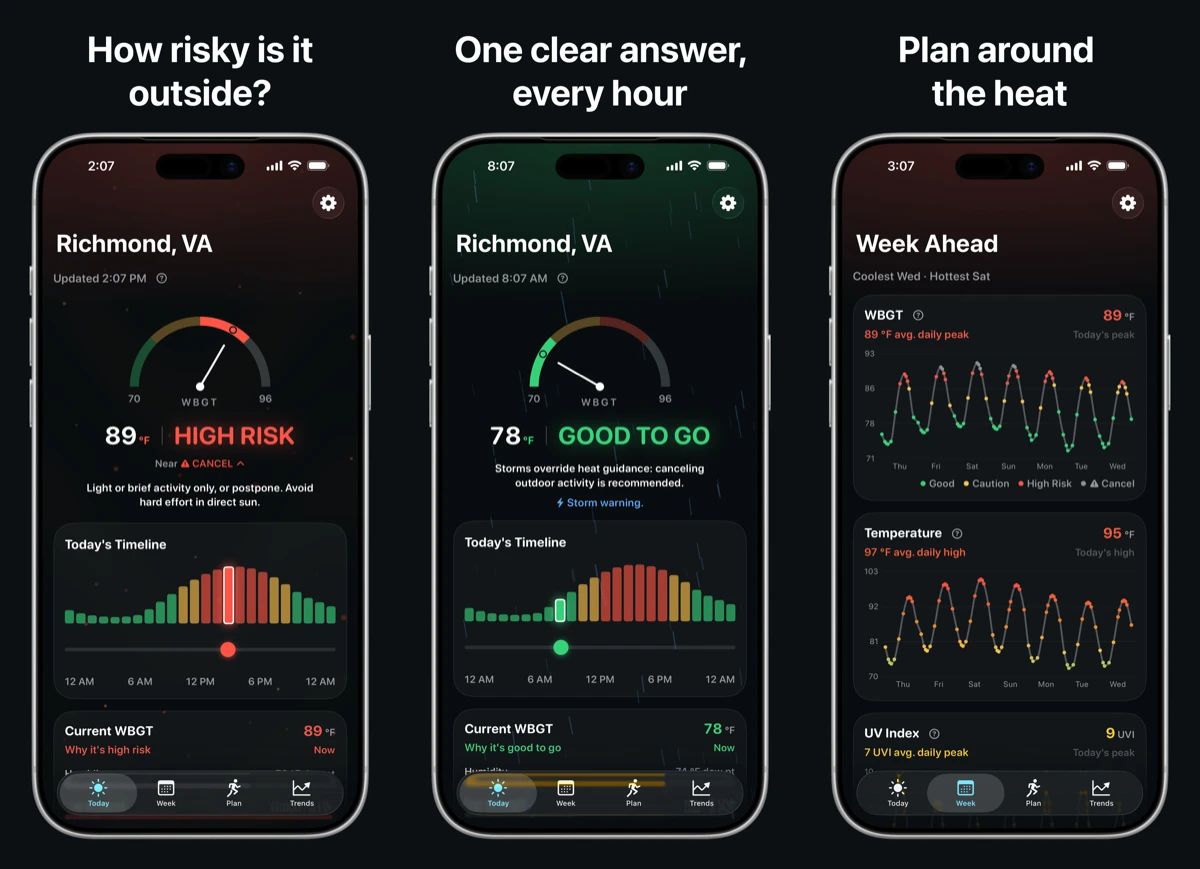
Swelter offers a number of other useful features, such as:
- Push notifications (heat alerts, precipitation alerts, storm warnings, etc.)
- WBGT and weather conditions for the week ahead
- Dozens of beautiful charts for detailed weather insights
- Widgets for your Home Screen and Lock Screen
- Beautiful animations throughout the app, along with a live animated background showing current heat and weather conditions
- Support for dark and light mode, and iOS 26+ Liquid Glass design
- Customization options in Settings to control the appearance and functionality of the app
- On-device WBGT calculations using Apple Weather data, so your data remains private
- Best window planner so you can easily see the most favorable time to be outdoors today
- Trends comparisons so you can compare this week to previous years
- Unit selector so you can use the app in Fahrenheit or Celsius, depending on your locale and preferences
- Location picker so you can view anywhere on Earth
Notes From the Developer
I built Swelter because I wanted an app that clearly tells me how risky, or how favorable, current conditions are for outdoor activity. I am a runner, and summers here in Richmond, VA (and around the world) are getting hotter. When you mix in humidity, air temperature, sun, and wind, it’s difficult to know how dangerous current conditions are for outdoor cardio and activity. Swelter makes it easy to understand if it’s good to go outside right now, if you should postpone for a better time later in the day, or if you should cancel outright.
These numbers aren’t just guesswork, either. When building Swelter, we looked at published research and guidance from leaders in the field of outdoor heat safety, and used that public research to create an algorithm that estimates WBGT from Apple Weather data at your location. No WBGT algorithm can ever be as accurate as a physical sensor. That’s why we validated and fine-tuned our algorithm by comparing its outputs against Japan’s national heat-stroke monitoring system, the world’s largest WBGT monitoring network, whose hourly values are computed from measured weather-station data (including measured solar radiation) and are publicly available. Using this network, we compared tens of thousands of station-hours of data to make our algorithm as accurate as we could: in our July–August 2026 comparison, it reached 90% exact flag-for-flag agreement, and 99.96% agreement within one boundary step (the same borderline readings the app calls out with its “Near …” line).
Thanks for using Swelter. I hope it helps you find the best windows for runs, workouts, and everything else you love doing outside. Have a great summer!
- Gavin, developer of Swelter
To suggest a feature, report a bug, or get help with the app, get in touch.
Swelter is an independent product of RBRN Labs LLC and is not affiliated with, endorsed by, or sponsored by any of the organizations, agencies, or authors cited here or elsewhere on this site. Threshold values and guidance are drawn from their published, publicly available materials. The July–August 2026 comparison used measured station inputs; day-to-day readings come from forecast data and can vary more. Weather data shown from Apple Weather.